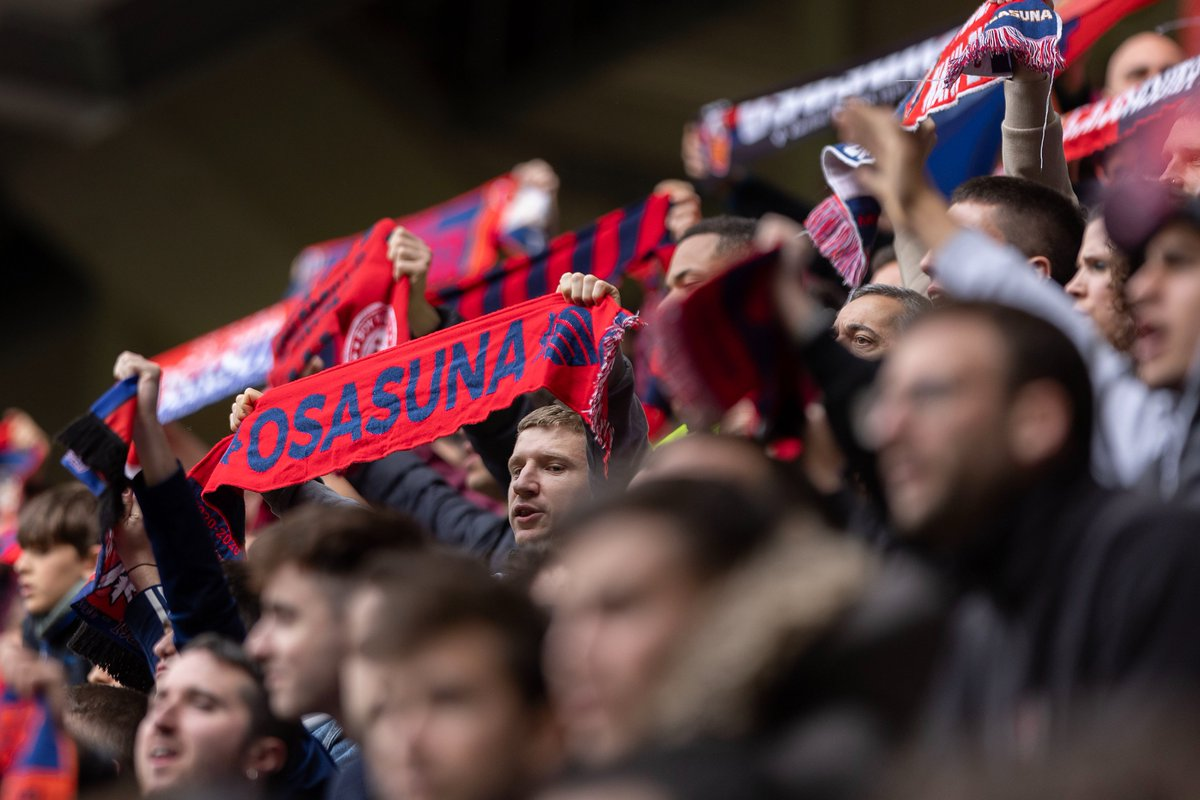
“Weak against the strong, strong against the weak.”
This sentence is what Osasuna posted on 06/23/2023 in a statement about the recommendation of the EUFA investigator for their disqualification from the Conference League 2023/24.
The statement is clear about their disagreement with the final results. The club posted a statement on 06/07/2023, stating they were aware of the investigation carried out by UEFA regarding the events that occurred more than a decade ago and explaining their position and willingness to help justice over the case. But what they found was not just an earned qualification on the field being rejected for non-sports related issues, but a punishment over the fact that the club dared to challenge irregularities in the past made by the people who used the club for their own without thinking about the fans.
Why? Well, it is a long journey that involves match-fixing, 90-minute goals that change everything, and never give up.

Six points with six points remaining separate eight clubs going to the last two matchdays in La Liga 2013/14. After losing 0-2 at home against Celta Vigo, Osasuna went to the last two games in the worst position to achieve salvation. The odds were not defied after they got four of six points, as more was needed, with the club finishing 18th with 38 pts which result in the regelation.
A crazy last match day for La Liga, just as one just finished. But that relegation was just the begging for Osasuna in its fight against itself and its twilight journey, which led for the first time in Spain, a court issued a sentence for sports corruption due to match-fixing in the “Osasuna case.” in April of 2020.
The former managing director of the club Ángel Vizcay; ex-president Miguel Archanco; former directors Juan Pascual (who died in the summer) and Txuma Peralta; and former treasurer Sancho Bandrés have all been handed prison sentences for charges including misappropriation of funds, and match-fixing. Even though in the case, only the Real Betis – Valladolid and Osasuna – Real Betis matches of the last two match days of 2013-2014 were prosecuted, with former Betis players Antonio Amaya and Xavi Torres also given prison sentences of one year, in which the club from Navarre supposedly paid 650,000 euros to the Real Betis for beating Real Valladolid and losing in Pamplona. Vizcay’s lawyer told the Course more matches also were fixed. In the previous season, he indicated, Osasuna would have paid the same amount to Real Betis for beating Celta, 150,000 euros, to Real Valladolid for beating Deportivo. And 400,000 euros to Getafe for letting them win. To avoid relegation, 1.6 million euros were allocated to fix six games in the 2012-2013 and 2013-2014 seasons.
The club hit rock bottom with relegation, both on and off the pitch.
“We had to face three important crises, the biggest in our history.” Managing Director Fran Cana lists them: “An economic crisis, which made the coffers empty and with payments to attend to; a credibility crisis, because the sponsors at that time did not want to know anything about Osasuna, they did not want to associate with us; and there was even a supplier crisis because they didn’t know if they were going to charge.”
Debts with clubs for old transfers, unresolved payrolls, operations more expensive than initially said, etcetera, were the expected day for the board to deal with it. All of this, plus the discomfort from the fans, led to Osasuna’s then-president, Miguel Archanco, departing on July 16, 2014. That day, workers from the electricity company approached the El Sadar stadium to cut off the power due to non-payment—an image of how the entity was at that time. Javier Zabaleta and the management board took over the club until the elections in December of that same year, as Luis Sabalza became president of Osasuna. He had a heartfelt and straight mission: return Osasuna where it belongs.
With that goal in mind, he and his vice-president Pedro Baile presented in February 2015 in the Investigating Court of Pamplona and filed a complaint after detecting money outflows worth 2.4 million euros without justifying. Javier Zabaleta declared in EFE: “We felt the need to do it because we thought it was the best for Osasuna. We Navarrese have always felt very proud of our club because it is an honest and compliant club, and everything that happened in those years makes us deeply ashamed. That’s why we wanted to go to the end with all the consequences.”
That was the origin of the “Osasuna case.” An investigation in which the club acted as a private imminence persecuting its former executives to repair their club’s image.
The debts were a constant problem for the club. It was almost five times Osasuna’s budget in the second division. They had to reduce the entire structure of the club, and Sabalza had to mortgage everything he had, and for several months he lived on what some friends lent him. As he declared: “There were debts everywhere, cobwebs in the safe, relevant documentation was missing on many issues, and every day we entered the offices, we had some unpleasant surprise.”
Their first full year, 2014/15, was a chaotic season as they could only win more than two games in a row: three, between matchday 17 and 19. After 40 intense matches, an 2-0 win at El Sadar on the penultimate matchday of the season means they travel to Sabadell already descended, knowing one point was enough to avoid relegation.
But it was easier said than done, as just 20 minutes in the game, Osasuna was already losing 2-0. As if that was not enough in this horror movie, Racing scored the only goal of his game at 31 minutes to send Osasuna to Segunda B, the third vision of Spanish football. But a miracle occurs. David García scored with 10 minutes remaining. Javier Flaño header home a corner to secure salvation in the last minute of added time. Everything could fall apart if it were not for that goal. Enrique Martín Monreal was the coach who took charge of Osasuna that season with six games to go, and in the next season, he did a magnificent job getting promoted via a play-off. But his return to the top flight in 2016/17 was rather disastrous. In eleven matches, Osasuna lost six, drew four, and won one. With seven points and in 19th, four points away from safety. Monreal was sacked and replaced with Joaquín Caparrós. The Spanidiar had five games to change their fate, but they lost all five games and was later replaced by Petar Vasiljević. But things did not work either, as they got relegated with only 22 pts and four wins all season. The reality was that they were not at that level to compete in the first division. As was known by CEO Managing Director Fran Canal: “For many years, all the money that entered the club immediately went out to pay the debt,” says Canal. “We managed to get promoted to the First Division, and there the president was very clear about it. We had to take advantage of that promotion to pay off all the debt we could. The team was practically relegated in December, but that year it helped us to return to Second in a very different situation.”
The following season, 2017/18, they brought Diego Martinez with high hopes of quickly coming back to La Liga, which was almost accomplished. Still, a 2-0 defeat at Valladolid in the last matchday and Numancia’s victory 2-1 over Cultural Leonesa will fade away the option of promotion via playoffs as they were one point behind Numancia. Despite the deception of missing the promotion opportunity, it felt like the club was moving forward and just needed to take the proper steps. Even though Diego Martinez did a good job, something was missing. And who better to replace him than the man who stole their ticket to the playoff? Jagoba Arrasate was the manager of Numancia for the last three years, and in his final season, they reached the playoffs final with one of the lowest budgets of the entire division. He was appointed to take charge of the 2018/19 season, and with almost the exact players, he won La Liga 123 and got promoted to La Liga. The following season he comfortably keeps Osasuna in 10th place, four points away from Europa League qualification. Jagoba Arrasate created a recognizable team: with a 4-4-2, high pressure, and either long ball or playing the ball out of back. Osasuna was a dynamic team who feared nobody. Some special was in the making, and Jagoba Arrasate was the man to build it. But this was tested the following season, 2020/21.
After nineteen matches, Osasuna was 19th with 16 pts. Only three wins and winless in the last thirteen games. After the nineteen match, a 1-1 draw at Valencia, sports director Braulio Vasquez declared in the press conference: “Jacoba is our captain, and with him, we will go to the end.” They won the next four of six games. They finished 11th, ten points above the relegation zone, and with the feeling that this team would never give up. Another 10th in the 2021/22 season means the club established themselves in the first division of Spanish football. And in 2022/23, they will take a step forward. A 7th place finish and reaching Copa del Rey final after beating current champion Real Betis on penalties, Sevilla, and Athletic Club in extra time resulted from such trust in Jagoba Arrasate. A long journey will please all fans of Navarre and the world to see the success of such a well-run club. But the happiness did not last long.
Three days after their 2-1 win over Girona on matchday 38, on the 7 of June, the club received by EUFA that they would make a disciplinary investigation. The “Osasuna case,” which finished in 2023 with a prison sentence for ex-executives, would break the rule of article 4.1 of the competition regulations. In this, they declare any club should “not have been directly or indirectly involved, since the entry into force of Article 50 of the UEFA Statutes, that is, on April 27, 2007, in any activity intended to organize or influence the outcome of a match.”
Furthermore, article 50.3 of the Disciplinary Regulations establishes that: ”if any activity intended to occupy or influence the result of a match at a national or international level occurs, UEFA will declare said club ineligible to participate in the competition”.
They are 100% right, as Spanish courses declared the former board of directors guilty of such wrongdoing. This brings us back to the begging when Osasuna post the statement explaining his disagreement with the result from the UEFA inspectors. The club was evident in his statement about how the Supreme Court ruling in the “Osasuna case” was evidence of transparency, as that condemns several ex-directors and was executed in the first place by the current managers of the club back from 2015 until this day, with Osasuna leading private accusation to explain the money who diverted from the entity for unclear purposes.
Fran Canal explains: “But it’s not easy. How do you now tell a president who arrives at a club and sees something obscure or illegal that he should be brave and denounces? What they are doing is discouraging the fight against corruption in football, and that’s something that would have to make us all reflect”, he concludes.
A similar case could help predict what outcome can happen in the following months: Besiktas was excluded from European competitions during the 2013/2014 campaign after confirming a match-fixing in the final of the Turkish Cup 2011. After winning his Euroa League play-off round against Tromsø, the club was disqualified and replaced in the group stage draw by Tromsø itself. Despite Besiktas’s efforts, the EUFA decision was endorsed by the UEFA appeals body and The Court of Arbitration for Sport (CAS).
The CAS remarked that “member associations and clubs are responsible for the conduct of their players, officials, fans and any other person who performs a function in a match on behalf of the association or club.” In practice, this means that the clubs may be penalized for the behaviors of those who act on their behalf. This is the case of Osasuna, despite more than nine years having elapsed since the illegal conduct was carried out, and the current manager board of the club was the one who denounced said actions.
Osasuna had already expressed their initiative to take all legal actions to resent the appropriate allegations before the Appeals Committee to fight to the end defending the interests and rights of the club. If UEFA finally decides to penalize the club, it may appeal the decision made before UEFA’s own Appeals Committee. If said body ratifies the previously adopted decision, Osasuna must go to the TAD waiting for a resolution favorable to its interests and which, in any case, will be final.
Whatever happens in the end, what is clear is that EUFA is penalizing Osasuna’s community and their current board, which not only do they have nothing to do with the illegal conduct, but they were precisely the ones who filed the complaint to recover the stolen money and clean up the club’s image. All that is left to do is to wait for the decisions.
Leave a Reply